It was 2017 and casino gaming was thriving. The American Gaming Association (“AGA”) could hardly contain its excitement in its 2017 State of the States report (PDF):
2016 was a banner year for both the casino gaming industry and for AGA. For one, the industry has continued its upward growth trajectory, once again setting a new record for gross gaming revenue. In addition, our industry took major strides into becoming ever more mainstream. A presidential debate was held in Las Vegas, a former casino owner was elected president of the United States, and both the NFL and NHL approved franchises to be located in Las Vegas.
Commercial casinos operated in 24 states. Add tribal, racetrack and riverboat casinos and the number swelled to 40. Commercial casino gaming had finally shaken off its post-2008 recession woes, delivering a record-setting year:
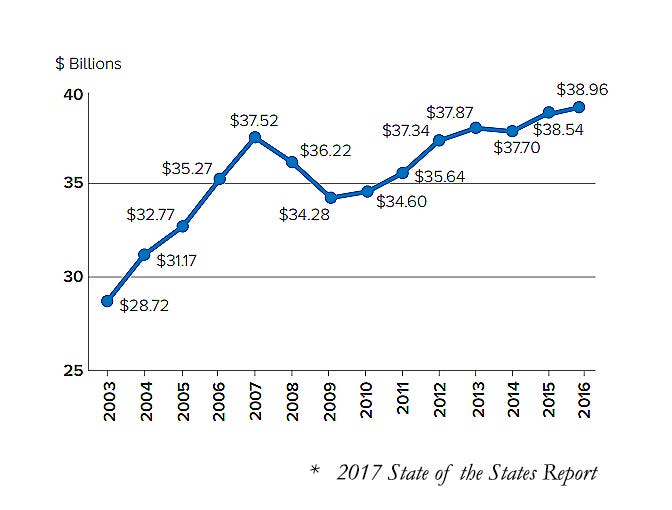
Casinos were everywhere–commercial, tribal, riverboat, you name it. Sports gambling (wagering on single game outcomes), however, was confined to Nevada. Adam Silver, NBA Commissioner then and now, had already penned his infamous New York Times op-ed Legalize and Regulate Sports Betting, calling for reform. With PASPA headed to the Supreme Court, the AGA saw its golden opportunity:
The AGA is honored to harness this momentum and lead the advocacy efforts of the newly formed American Sports Betting Coalition (ASBC), a diverse alliance of law enforcement groups, elected officials and policy organizations that believe in the need to overturn America’s sports betting ban.
It even filed an amicus brief (PDF), passionately arguing for regulated sports gambling:
The AGA—like the majority of sports fans and many leaders in law enforcement—believes it is time to reexamine the nation’s outdated sports-betting laws.
The problem? Sports gambling, was–and still is– a federal issue. States lacked jurisdiction. To expand its reach, the AGA needed states to encroach into federal territory. So it leaned on a “state rights” argument before SCOTUS. However, the case law it cited did not support its position. In fact, we called them out in our own amicus brief (PDF):
As an initial matter, there appears to be a fairly universal consensus that gambling and gaming are equivalent, and the terms are commonly used interchangeably. The American Gaming Association (“AGA”) correctly observes that “[t]raditionally, gaming regulation has been a matter of state and local concern,” but later asserts that PASPA, a law about sports gambling, is problematic because it “contradicts this tradition of federal deference to state gaming laws.” Brief of the American Gaming Association as Amicus Curiae in Support of Petitioner at 18, Gov. Christie et al. v. Nat’l Collegiate Athletic Ass’n et al. (Nos. 16-476 and 16-477) (November 2016). The only case cited by AGA in support of its argument is Greater New Orleans Broad. Ass’n v. United States, 527 U.S. 173 (1999), which according to AGA asserted that: “Federal policy is ‘to defer to, and even promote, differing gambling policies in different States.’” Id., at 187. However, the full sentence shows that this Court made this statement in the context of lotteries and casino gaming: “That Congress has generally exempted state-run lotteries and casinos from federal gambling legislation reflects a decision to defer to, and even promote, differing gambling policies in different States.” Id., at 187.
Our plea for linguistic precision was not heeded and PASPA was repealed. The AGA garnered a couple of mentions in the Supreme Court opinion (PDF) and many states joined in on the gold rush. For 6-7 years (sorry, couldn’t resist), it looked like a triumph.
Until it didn’t.
Now the AGA has lost the narrative and is on the defensive. It opposes prediction markets. It broke up with DraftKings and Fanduel (see our LexBeyond podcast Ep. 2). The AGA is even running anti-prediction market ads:

Source: US iGaming Hub

Kalshi has the states, tribes, and the AGA exactly where it wants them–clinging to a jurisdictional argument that has never genuinely existed. States have never had jurisdiction over sports gambling and may never.
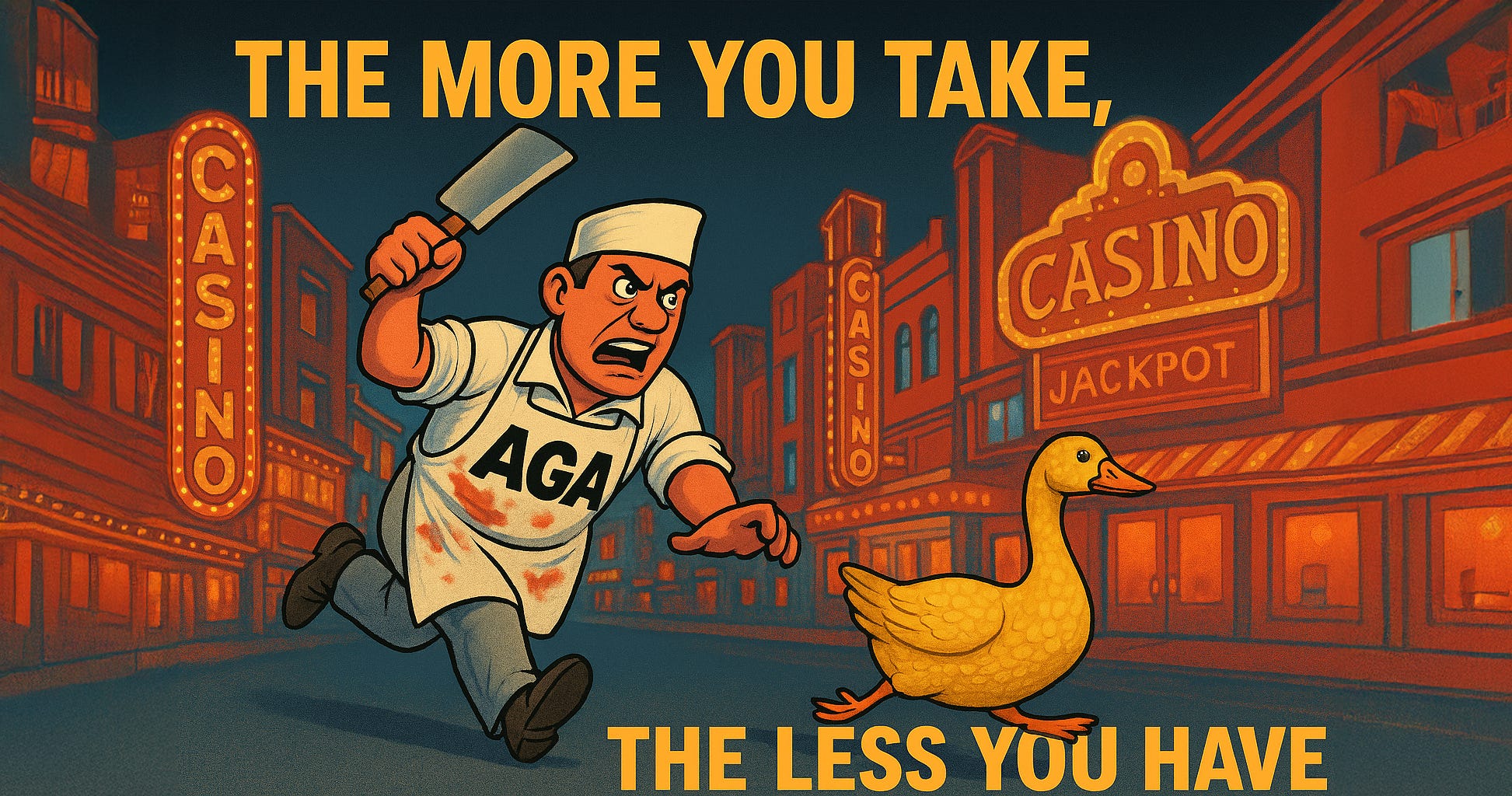
Casino gambling was the golden goose: widespread, steady and socially rooted. Sports gambling was the shiny prize, limited to Nevada and the AGA wanted it all. Instead of nurturing the goose, they tried to cut it open and take the instant gold.
The result? Fierce competition and a shift in consumer behavior. Casino gaming, even with all its flaws, is still a social event: gamblers get dressed up, travel, interact with dealers, chat with strangers, host parties, enjoy drinks and even a steak dinner. Sports gambling, by contrast, is mostly solitary and sedentary–gamblers become couch-bound, phone in hand mindlessly clicking away and pissing away money they likely couldn’t afford to lose.
The states are in quicksand. Early legal victories seem unlikely to hold up and instead of chasing short-term gains, states, tribes and the AGA should be focusing on the long-term viability of casino gambling. The genie is out of the bottle–it will never be 2024 again.
Unless the gaming constituency changes course, it may never be 2017 again, either.