


Our hypothetical SEC employee started their journey on June 1. Third week into the job, the crypto research continues…
You actually feel a little down today. After hearing Michael Saylor advocating for Bitcoin, and Ric Edelman, a top personal finance expert doing the same, you are coming to the realization that the rabbit hole goes deep, really deep. At the same time, you are determined to see how deep it goes, just like Neo in The Matrix. One, you are drafting an investor alert bulletin and you want to do a good job. Even more importantly, you care about the SEC’s mission: to protect investors. You have a feeling that your research could really shape the policy.
“What should I do today?” you ask yourself. You reflect back on your MBA days. It was a good time. You have learned that when a seemingly random memory occupies your mind like this, it’s never random. It is your brain trying to tell you something.
“Of course,” you say to yourself. “I need to go a bit deeper on the academic side. I have researched Aswath Damodaran quite a bit, but what else is going on in the halls of academia? What do today’s MBA students learn about crypto? What do executive MBAs learn about crypto?”
You pull the latest U.S. News ranking. The Wharton School (University of Pennsylvania) is #3 in best business schools, and #1 in executive MBA. You decide to take a look.
A few clicks, and you find what you were looking for. A six week online certificate program:
Economics of Blockchain and Digital Assets
When they first introduced the program, which was $3,800 at the time, they were even taking tuition in crypto. “Good marketing,” you say to yourself.
Is there a brochure somewhere? Yes, there is a PDF right here:
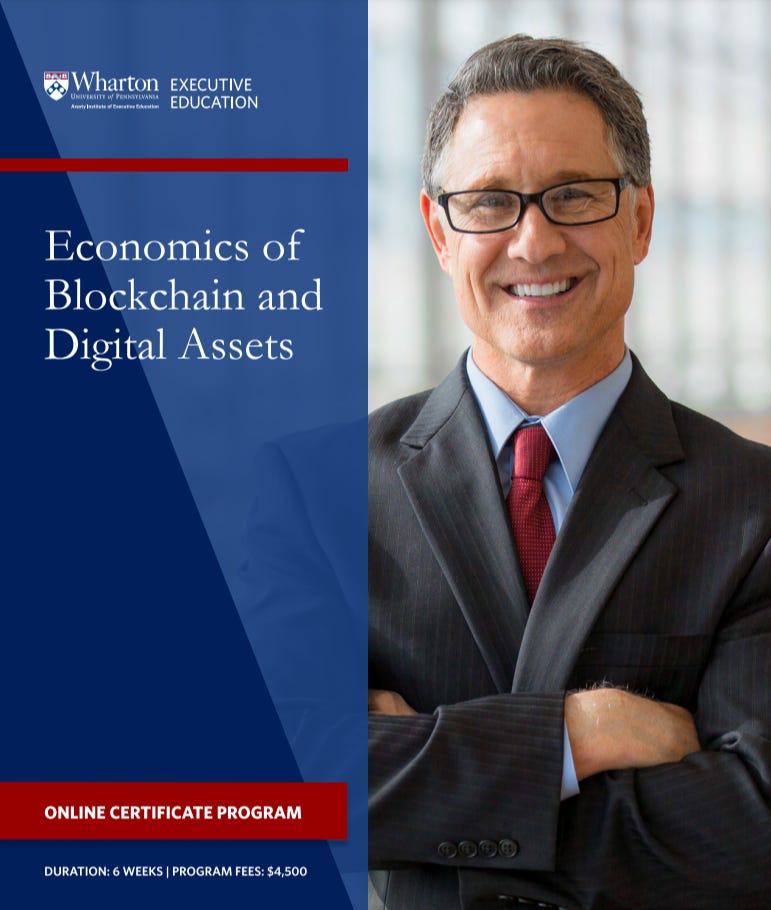
Ok, what can one expect from this program? You start going through the brochure. There is a quote from Abigail Johnson, CEO of Fidelity Investments.
I love this stuff-Bitcoin, Ethereum, blockchain technology- and what the future holds.
Of course. Even Munger, arguably the most outspoken critic of crypto, said the technology is cool. The issue is not the blockchain technology, it is whether one can “invest” in crypto. You look at your notes from yesterday. When Fidelity announced its plans, Abigail Johnson got not one, not two, but three letters from Congress.
You flip to the next page:
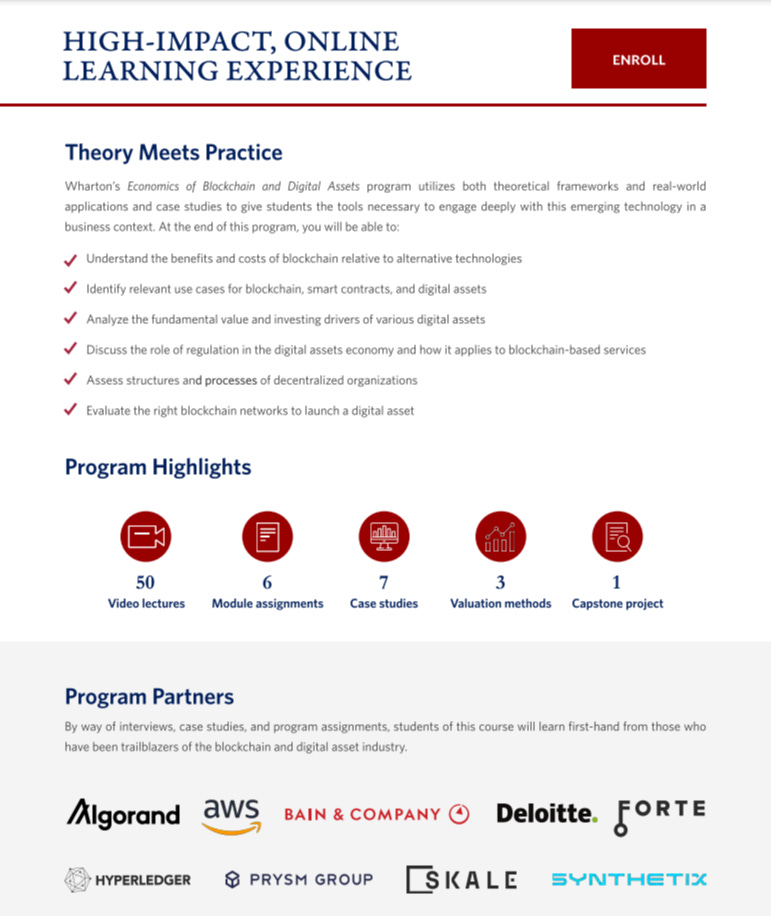
Something you totally expected to find, but were hoping not to find. There it is, the third bullet:
Analyze the fundamental value and investing drivers of various digital assets
“Well, over at Stern, they are saying, at least Aswath Damodaran is saying that one cannot invest in crypto. Over here at Wharton, students are analyzing the investing drivers. What gives?”
You realize that people don’t have to agree on everything, but this disagreement strikes you as fundamental. “Obviously we may not agree on the value of a stock or what discount rate to use. But if we can’t agree on what investing is, then we have a real problem. What is investing, after all?”
How exactly can crypto be valued? You remember from early last week that crypto may have value, but it cannot be valued. You flip through the pages of the brochure and the next page offers some clues:
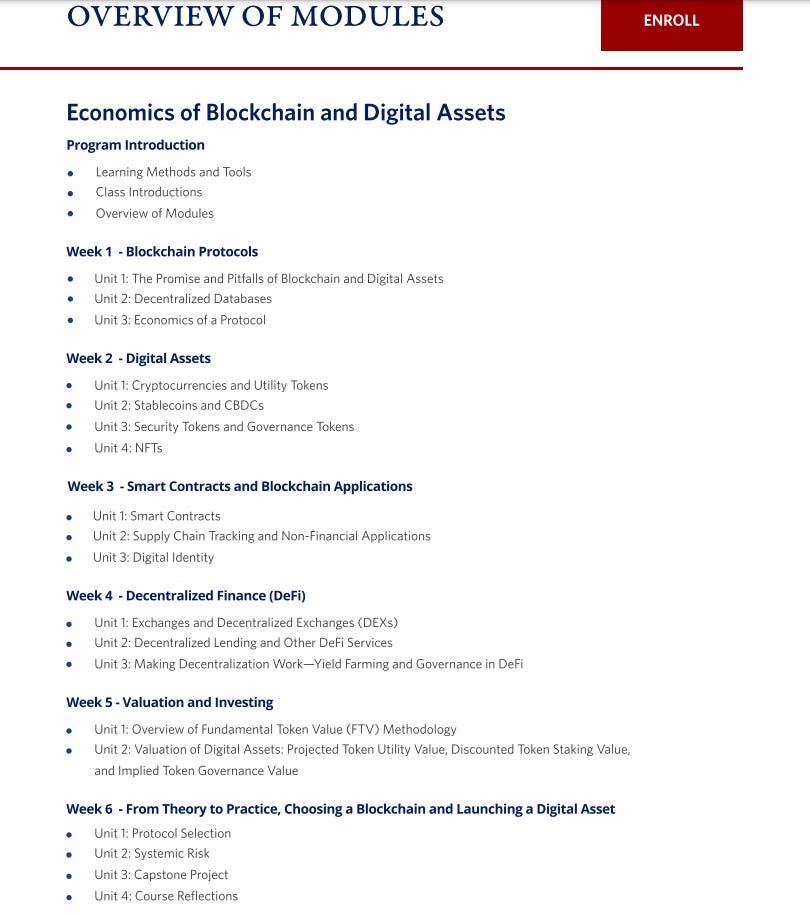
There it is:
Week 5 - Valuation and Investing
Unit 1: Overview of Fundamental Token Value (FTV) Methodology.
Unit 2: Valuation of Digital Assets: Projected Token Utility Value, Discounted Token Staking Value, and Implied Token Governance Value
At first glance, FTV sounds like a play on FMV (Fair Market Value).
“Well, I can value a staking contract,” you say to yourself. “But I cannot value something that does not generate any cash flows.”
You feel even more frustrated. Surely, there are useful parts of the program. The investing/valuation piece seems just wrong, however, at least based on what you are seeing in the brochure. The rabbit hole just got a little bit deeper.
