The past couple of days have revolved around illustrating examples along the investment-speculation spectrum. On Friday, we experienced day, night and the sunset in between. Yesterday, we drew upon a traffic analogy: tailgating. Traffic provides us with a plethora of examples that resonate deeply with us because, let’s face it, when we drive, safety is paramount. Similarly, investing used to prioritize safety, a notion that has largely been forgotten, almost appearing novel these days. Hence, we will continue our series with another traffic-related example.
Consider this: Why do speed limits exist in the first place?
Speed limits are in place because ensuring collective safety is in the best interest of society. If you drive comfortably below the speed limit, the risk remains low – or at least, that’s what I, the author of this piece, believed while taking a driver’s test in California. Having engaged in some unsafe tailgating in a previous life, I realized that I needed to exercise more caution during my test. My thinking was that if I stayed significantly below the speed limit, I believed I would be deemed a safe driver by my instructor and pass the test.
However, I was mistaken. I failed that test. My instructor informed me that he actually stopped counting my mistakes because I was driving too slowly, which posed a different traffic hazard. I am still a bit puzzled as to how I endangered others by going 25 mph in a 35 zone, but c’est la vie.
Setting aside my personal trials and tribulations in traffic, when it comes to investing, there is no such thing as driving too slowly.
What do we mean by that? Let’s set aside the question of whether my driving instructor was right or wrong. While the analogy may not be flawless, we believe it is still adequate to equate driving below the speed limit with safety. In the realm of finance, the equivalent concept is being in the investment zone.
Remember, the simple definition of investing is buying cheap apple trees. In other words, if the price is significantly lower than your value estimate, there is a satisfactory margin of safety, and you are investing rather than speculating. To clarify, this doesn’t imply that a well-intended trade with a solid investment hypothesis, a robust valuation estimate and an ample margin of safety can’t go awry. Even seasoned investors Ben Graham and Warren Buffett have experienced occasional setbacks. Just as accidents can happen regardless of how cautious you are, not every trade will yield a favorable outcome, even if you are genuinely investing. Occasionally, the right process can lead to suboptimal performances.
What remains true is that if you are extremely careful every time you drive:
You have a lower chance of getting into an accident; and
Even if you do have an accident, the damage will likely be manageable.
The same holds true if you approach every buying opportunity with the same level of prudence and safety that you deploy with your driving:
You will experience fewer losing trades; and
Even if you do have losing trades, the losses will likely be manageable.
Indeed, even if you are a true investor, you may encounter unfavorable trade outcomes or even endure difficult years. However, with discipline and adherence to investment principles, it is probable that, over the course of a lifetime, you will ultimately emerge with positive results, and in certain instances, may achieve substantial success.
What if you are just slightly above or below the speed limit?
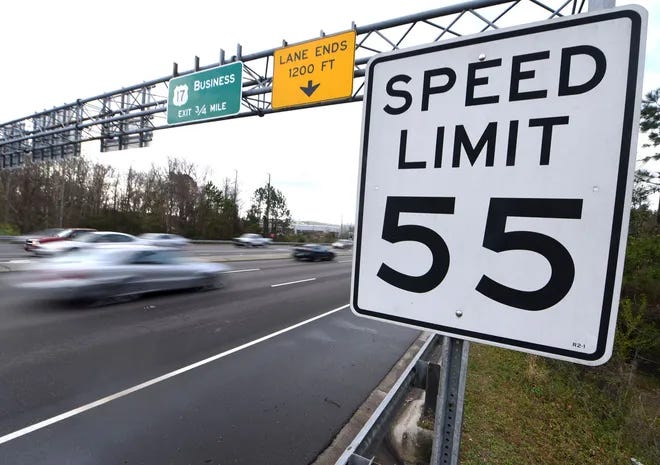
If you are slightly above or below the speed limit, you obviously didn’t give up safety completely, but it is in that zone where safety begins to disappear; there is less room for error. The analogy can still hold true in the realm of investing. Just as driving slightly above or below the speed limit may not significantly impact safety, being slightly above or below the estimated value in investing may not drastically alter the investment's potential. That said, it begins to disappear. Is it fair to still call purchases in this zone (where the price is close to the estimated value) investing?
We don’t think so, and luckily we don’t need to. When the sun is setting, we don’t want to call it daytime, but it’s not exactly nighttime either, it’s a little bit of both. We are in that middle zone where day turns into night, and the dictionary, luckily, has a word for that: sunset.
The finance lexicon has a word for that middle zone, too: it’s called speculative investing. It’s not fair to characterize purchases in that zone as investing, because true investing needs an adequate margin of safety. At the same time, the price is not well above the value estimate either, so it’s not fair to call purchases in that zone speculation, either. We are truly in that middle zone, engaging in a little bit of both. Perhaps the chosen phrase “speculative investing” is etymologically-challenged; it is certainly not as imaginative as “sunset”, but it gets the job done. It is a phrase that literally combines two words and describes the area on the spectrum where one blurs into another.
What happens if you are driving well above the speed limit? We believe you already know the answer. Day turns into night, and investing transforms into speculation. It transforms into speculation precisely because the margin of safety is now entirely gone.
So, it begs the question, three in fact:
Why do some people choose to be unsafe when their lives are at stake?
How can we expect to prioritize our financial well-being if we struggle to prioritize our safety when our lives are on the line?
If we mandate speed limits, should we also control excessive speculation?
These are all excellent questions that we will tackle tomorrow.