

Misinformation Mondays: What Social Media Has Wrong
The “Investing Is Gambling” Fallacy - Again

Prediction markets are hot.
And as usually happens when something really heats up, the misinformation starts flying. The latest example comes from Jason Trost, Founder/CEO of Smarkets, another prediction market:

He may be correct about industry consolidation, but that’s not the issue here. The problem is this claim:
Gambling vs. non-gambling is a false debate. Gambling is a motivation, not a product. A sports bet is a financial contract. The “gambling” aspect comes from horrible pricing and a user’s willingness to pay it.
No. That’s not how U.S. law works.
Gambling vs. non-gambling is not a false debate. The gambling characterization determines whether a product can legally reach the market. In that sense, gambling is a product category–because it has to be. The law cannot hinge on unknowable user motivations. People’s intentions are not observable, measurable or administrable. So the tests must be tied to the product itself.
A quick reminder: The legal process diverges depending on whether you’re dealing with games or futures.
When it comes to games, the skill vs. chance spectrum is what matters:

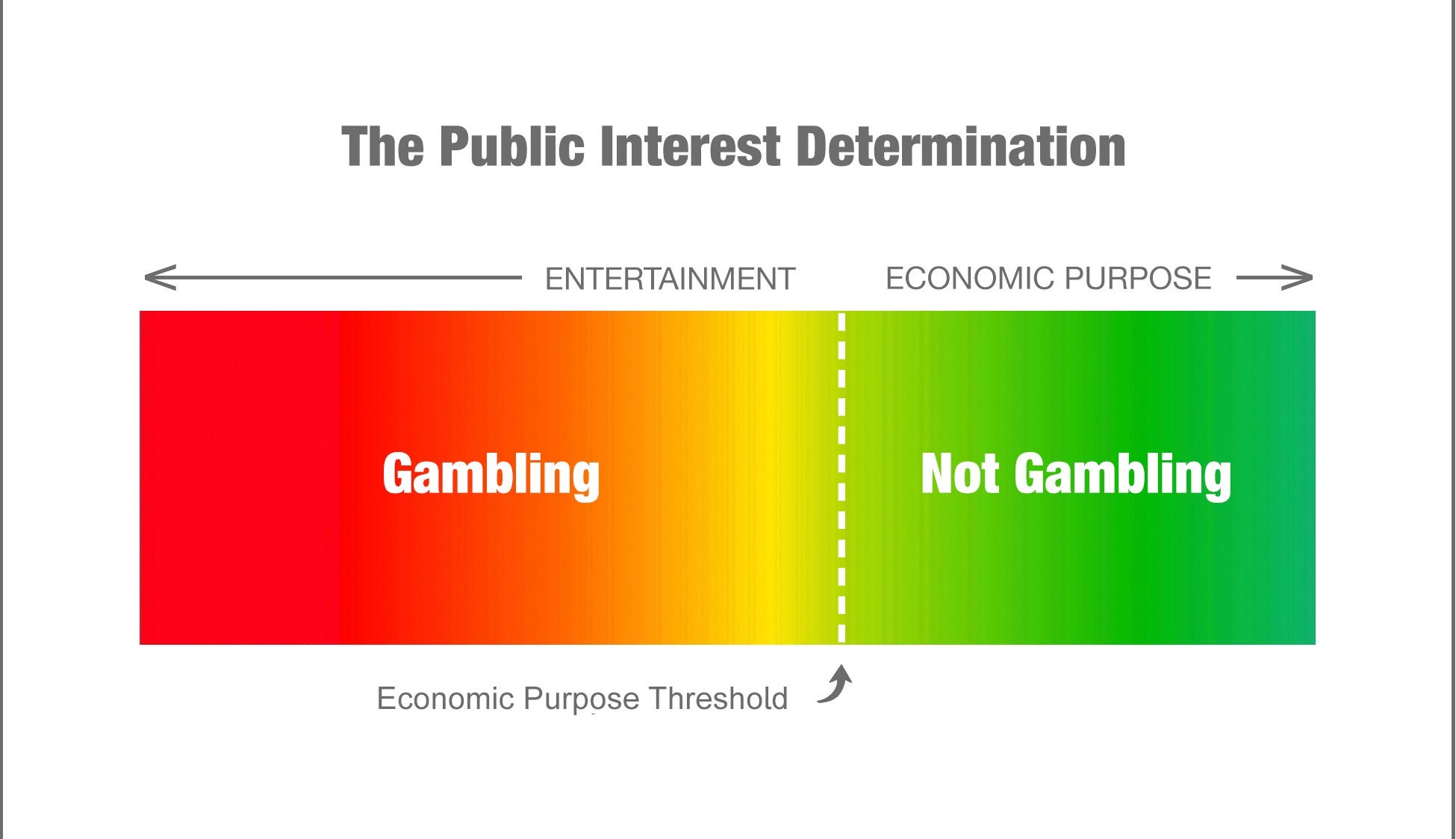
When it comes to event contracts–and here Jason is correct that a sports bet is a financial contract–the relevant test is the public-interest determination:
Jason also misfires when he says:
You can gamble on stocks.
No, you can’t Jason. No matter how much it might feel like gambling, it’s not gambling. You can speculate, absolutely--but that doesn’t make it gambling. Here is the correct framework for this:

Price below value + margin of safety → Investing
Price below value but shrinking margin → Speculative investing
Price above value → Speculation
Buying blind with no valuation → Speculation
Gambling on stocks? Never. That is simply not a thing.

And here’s why the distinction matters: if we collapse investing and gambling into the same bucket, we collapse the regulatory frameworks that keep markets functioning. Gambling law is built around consumer protection and paternalism; securities law is built around disclosure and capital formation. Mix them up, and you either (1) suffocate legitimate financial products under gambling rules, or (2) let gambling products slip through the cracks by pretending they’re “investments.” The entire system depends on keeping these categories clean. That’s why the law draws boundaries, and why the “investing is gambling” narrative isn’t just wrong, it’s dangerous.
Jason is right about this though:
You can invest in sports.
You absolutely can. But a sports bet is not an investment. You need an entirely different product for that–something most of the world has never seen before.
And we have that.
Stay tuned.

